
Blog

Solar Water Heaters, is a solar water heater the right choice for your home?
First things first, what is a solar water heater and how does it work? A solar water heater is very much like it soundS. It utilizes the sun to heat your water. In the Phoenix metropolitan area also known as “The Valley of the Sun” it makes sense that this could be a great idea because sun is something we have in abundance. In fact, I am pretty sure that Phoenix is closer to the sun than the rest of the planet. Anyone who has experienced a summer here would agree with me.
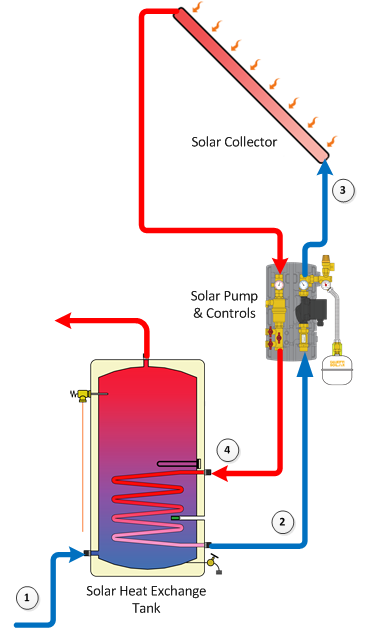 How does a solar water heater work?
To start explaining how a solar water heater works first, we must break down the different types of solar water heaters. I know what you’re probably thinking. “What do you mean types of solar water heaters aren’t they all the same”? Well the answer is no. There are actually 3 main types of solar water heaters. They all operate differently and require different components to work.
The OpenLoop Solar Water Heater
The open loop system is the simplest of the 3 systems. Basically, you have a tank that is usually an 80-gallon tank with a single heating element. Generally it is used as a back up heat source in case a solar component is out or it is not a sunny moment. The water starts by being pumped up to a solar panel on the roof. There, the heat is transferred from the sun to the water heating it up. The water is then sent to the tank to be stored for use.
In addition to the tank, pump, and solar panel the system will also have at least 2 temperature sensors. It also has a control module that will control when the pump runs to maintain the temperature in the tank. This system might be the most common because it is generally cheaper do to the simplicity of the storage tank.
The closed loop system
The closed loop system has all the same components as the open loop however there is a very big difference between the systems. That is the tank is very different and there is an additional fluid used for heat transfer. To be more specific there will be inlet and outlet ports for the water. There will be another set to the solar panel. The term closed loop is used because there is a glycerin-based fluid that is pumped through the solar panel.
Next it’s pumped through copper tubing that is wrapped around the tank transferring the heat absorbed from the panel to the tank. This system is also very common but there is additional cost in equipment. With this system you can expect additional cost of the tank design and manufacturing. The thought process behind this system however, is that the glycerin based fluid is less corrosive. Therefore the panel and pumps should last longer.
The drain back system
The drain back system is also referred to as a piggyback system and is a closed loop system too however, it can be used with water or a glycerin-basedfluid. It also has a pump that pumps the fluid up through the panel and to the tank but it also has an additional reservoir that hold the heat transfer fluid when the pump is not running. So it “drains back into this reservoir. Ideally it is meant to lessenthe strain on the solar panel because it is not under constant pressure. There are some versions of this system that can be added to a standard water heater. It becomes the main heating source and then the standard tank heating source be it gas or electric becomes a secondary source of heating the water.
Savings?
To talk savings we have to know what the efficiency is of the solar water heating system. I will be going over how the different efficiency rating work and will try to simplify them as much as possible. If you would like to check out the technical data that can be found here.
So to determine the energy efficiency of a solar water heater you factor the amount of energy delivered by the system and divided by the electrical or gas put into the system. This will usually give you’re a solar energy factor of 2 or 3. Basically this means for every $1 you put into the electricity and/or gas you get 2-3 dollars worth of hot water.
Another solar water heater performance metric is the solar fraction. The solar fraction is the portion of the total water heating load. The higher the solar fraction the greater the contribution to the heating of the water from the solar panel. The solar fraction will vary dramatically based on the amount of pure solar energy that cam be utilized.
UEF Energy Efficient Rating
For simplicity lets stick to energy efficiency also know as the UEF. UEF is more commonly used to rate the energy efficiency. It’s used by many companies to rate their water heater efficiency. And we will utilize the calculations provided by the link above. I am going to forgo comparisons to gas water heaters. The only way it may come into account is when the piggy back system is used with a gas water heater and that is not a common situation.
The average 50 gallon electric water heater has a UEF of approximately .94. Generally they cost the average residential home in 2021 around $460 to operate for the year. Based on the calculations provided you could save an average of $275 a year with a solar water heating system. This would bring your average cost for hot water to about $185 in 2021.
So let’s take into account the upfront cost of a solar water heating system. Which will vary from system to system and your location. But here in the Phoenix metropolitan area you would be looking at roughly $12,000 to $15,000 with a life expectancy of 10 years on the tank and 6-8 years on other components. And this cost analysis i’d not including repairs to the system. In short based on the up front cost of a solar water heater and the average annual savings it provides you can expect to be making repairs on the system before it starts to pay for itself in savings. If you are lucky the components might last long enough to break even.
Services in Phoenix & Beyond
When you’ve found yourself in need of plumbing services in the Phoenix, Glendale, Scottsdale, or Chandler area, you can trust Robins Plumbing to provide you with prompt and expert care, contact our team today! In addition to our toilet services, we also offer a variety of residential and commercial plumbing services, including: drain cleaning, water heater repair and replacement, sewer camera inspection and locating, backflow prevention, commercial and residential jetting, water treatments, trenchless sewer repairand more. Visit our reviews online to see what others have to say about our local plumbing company!
Categories
We Specialize in All Your Plumbing Needs
Below are just a few of the services we offer.

We are licensed, bonded and insured experts here to help you with all of your residential plumbing needs.

We are licensed, bonded and insured experts here to help you with all of your commercial plumbing needs and we will get your business back up and running.

From whole home filtration systems to just having clean purified water at your kitchen sink, we're here.

You can count on us to handle your drain cleaning with quick, affordable and reliable service.